5% Off Your Next Trip. Hurry Up For your new Tour! Book Your Tour

thumbnail thumbnail thumbnail

The Machame route is also known as the Whiskey route, given its reputation for being a tough climb, in contrast to the easier Marangu route, which is known as the Coca Cola route. Unlike the gradual incline and hut accomodations found on the Marangu Route, the climbers on Machame hike steeper trails, for longer distances, while sleeping in tents.

The Machame Route climb can be done in a minimum of six days (five nights) on the mountain. However, it is most often tackled over seven days (six nights), for a better altitude acclimatization schedule. The trek begins at Machame Gate, located in the southern base of mountain, within its lush, fertile rainforest.

The route heads toward the Shira Plateau, before circling along the southern circuit halfway around the mountain, exposing the climber to great views from all angles. The approach to the summit is made from the east, and the descent follows the Mweka trail.

Included and Excluded

  • Qualified guides with mountain crew
  • National park fees
  • Hut/camping fees and tents
  • Tents foam sleeping pads, cooking equipment, and (Cutlery / Crockery) eating utensils.
  • Rescue fees (required by the National Park)
  • Pulse oximeters
  • First aid kit
  • Guides, porters, cook, waiter salaries
  • Boiled water on the mountain
  • Airport transfers (JRO - Kilimanjaro International Airports)
  • All meals on the mountain (breakfast, lunch & dinner)
  • Guides, porters, waiter, cook accommodation and entry fees on the mountain
  • Guides, Porters, Cook & Waiters tips
  • Meals and drinks not specified
  • Mountain equipment (eg sleeping bags)
  • Gear for your climb, Some equipment is available for rent. See our rental price list.
  • Car Supplement USD$145 per car for clients who go through Lemosho/Rongai/Shira Routes
  • Items of personal nature (expenses)
  • Emergency Oxygen
  • Additional nights beyond the two standard hotel nights included
  • Extra activities (waterfall tour, cultural village visit).
  • Visa fees & travel insurance.
  • Flight tickets.

Highlights of the Tour

Itinerary

You will be picked up at the Kilimanjaro International Airport and transferred to your hotel in Moshi town, you will meet your guide who will brief you on your upcoming trek and do an equipment check to make sure you have all the necessary mountain gear. The missing gear can be rented on this day. Meals: No Meals Included

One hour's drive from Moshi lies the gate to the Machame route, where we complete park formalities, meet our crew of porters and start to climb! The first section of the route climbs steadily and passes through magnificent, dense rainforest. This path is less well-trodden so it can get somewhat overgrown in places and it is often wet and muddy underfoot. Distance covered: 10.8km / 6.7mi Approx. time taken: 6 hours Meals: Breakfast, Lunch & Dinner Included

Our route continues on up through the forest until we reach the steep ascent onto the Shira Plateau, where there are rewarding views of the mountain. Looking back, you will be able to see Mt Meru rising high above Arusha town in the distance. Distance covered: 5.4km / 3.4mi Approx. time taken: 5 hours Meals: Breakfast, Lunch & Dinner Included

Walking now on high moorland, the landscape changes the entire character of the trek. We traverse the southwest side of Kilimanjaro, passing underneath the Lava Tower and the final section of the Western Breach and finally reach camp The day has been spent at altitude (up to 4600m), but we have followed the mountaineering code of 'walk high, sleep low' to aid your body's acclimatization to altitude. Distance covered: 10.8km / 6.7mi Approx. time taken: 8 hrs Meals: Breakfast, Lunch & Dinner Included

Our day starts by descending into the Great Barranco, a huge ravine. We then exit steeply, up the Great Barranco Wall, which divides us from the southeastern slopes of Kibo. It’s a climb over rock, not technical, but long and tiring. Passing underneath the Heim and Kersten glaciers, we head towards the Karanga valley, which is our last stop for fresh water before the summit. Scree now forms the terrain as we walk through arid and desolate land towards Barafu camp. Distance covered: 8.5km / 5.3mi Approx. time taken: 8 hours Meals: Breakfast, Lunch & Dinner Included

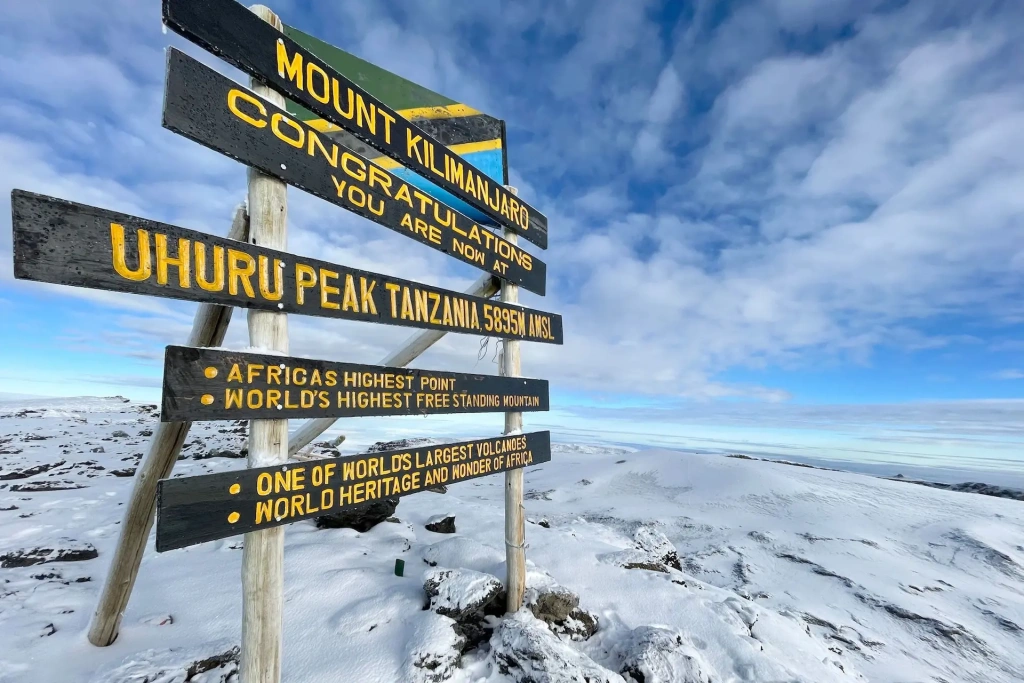
We start off at around midnight, and walk steeply upwards to the summit glaciers. We will be climbing scree for 4 to 5 hours but gain incredible height over a short distance. The views are spectacular. We should be on the crater rim at Stella Point (5739m) as the first rays of the sun hit us. Spectacular ice cliffs within the crater surround us and the views to jagged Mawenzi peak and beyond are breathtaking. Another hour’s walking takes us to the summit, Uhuru Peak (5895m). We begin our descent by returning to Stella Point and then descending on scree slope and track back to Barafu Camp for breakfast, before finally heading down to Millennium Camp for a long well-earned rest. Distance covered: 13.4km / 8.3mi Approx. time taken: 12 – 15 hours Meals: Breakfast, Lunch & Dinner Included

A gentle trek takes us down through the rainforest to Mweka Gate, where we complete park formalities and receive certificates, which you can hang up with pride! We are then met by our vehicles and return to the hotel in Moshi, where you can treat yourself to a welcome hot shower. Distance covered: 12.1km / 7.5mi Approx. time taken: 6 hours Meals: Breakfast, Lunch & Dinner Included

The day is left free to wind down after the trek before your flight home. Depending on flight times you could go and explore Moshi town and grab some souvenirs before heading to the airport. *Safari, Zanzibar and other add-ons are available if you wish to continue exploring Tanzania. Meals: Breakfast Included

Frequently Asked & Question

For most travellers it is possible to obtain a visa upon arrival but nevertheless, it is every visitor’s obligation to check the latest visa regulations with their respective embassies. Every traveller is responsible to be in the possession of the required travel documents.

There are a few things you should pack for a Kilimanjaro climb and as the list is quite extensive, you will receive a detailed packing list from us once you have confirmed the booking. For your convenience we also rent out all essential clothing items and other gear.

The warmest time with the least rainfall is between December and February, followed by the main rainy season from March until the beginning of June. Between June and October, temperatures are moderate with almost no rainfall. November is regarded as the small rainy season and daily short rainfalls with cloudy views are common. The best time to travel is between the end of June and the middle of October and although it is possible to climb Kilimanjaro in the main rainy season, we strongly discourage anyone from doing so.

Almost everybody climbing Kilimanjaro will be affected by the altitude in some or other way. Top athletes are just as much at risk of suffering from it as are people who are out of shape. Headaches, extreme fatigue, loss of appetite and nausea are all signs of possible mountain sickness. Symptoms are mostly mild, enabling you to continue your hike and only in very few instances are symptoms more acute, making an immediate descent unavoidable. Severe altitude sickness is a serious matter and you should bear in mind that it can be life threatening and at worst lead to death. It is also important to replace lost body fluids due to physical activity by drinking enough water. We suggest two to four liters per day along with magnesium to prevent muscle cramps.

Mountain rescue services in Tanzania can in no sense be compared to the ones found in the European Alps for example. If you find yourself unable to walk, you will either be carried or transported on a wheeled stretcher. As this is by all means a very unpleasant experience, it is important that you only push yourself as far as your body allows. Helicopters are hardly ever deployed as they can only land at a lower altitude. Please also make sure your health insurance covers you while travelling. If you are not adequately covered, we urge you to take out suitable travel insurance assuring all your medical expenses including rescue and repatriation costs are covered

Meals are included as mentioned in the itinerary. For breakfast there will be a choice of fruit, scrambled eggs, porridge, toast, jam, hot chocolate, coffee or tea. Lunch will be provided in form of a lunch box containing sandwiches, boiled eggs, chicken etc. For dinner you will enjoy soup and bread followed by meat or poultry along with starch (i.e. chips, mashed potatoes, pasta or rice) as well as vegetables. While breakfast and dinner are served in a mess tent equipped with a table and chairs, lunch is enjoyed en-route. Please let us know if you have any special dietary requirements or food allergies and we will do our outmost to cater for them (only possible with advanced notification).

Apart from very basic long drops (simple latrines), there are no further ablution facilities. Climbers are however provided with a bowl of warm water for their daily wash.

According to the national park authorities, children under the age of 10 years are only allowed to hike until Shira Camp 2 (3900 m). There are no official restrictions for children above the age of 10 years but because the chances of children succumbing to mountain sickness are a lot higher than they are with adults, we recommend a minimum age of 14-16 years. Please note that children of all ages have to be accompanied by one of their parents at all times. Although there is no maximum age restriction, a medical check-up is advisable for climbers above the age of 60.

You will overnight in two-man mountain tents equipped with sleeping mats. Single travellers often share a tent with another group member of the same gender, but single tents can be requested at extra cost.

Tips for the mountain crew are common practice. Gratuities are a large portion of the crew’s income and thus highly appreciated. Below are some recommendations from our side (per group, not per person): Guide: 15-18 USD per day Assistant Guide: 12-15 USD per day Cook: 8-10 USD per day Waiter: 7-9 USD per day Porter: 6-7 USD per day

Yes you should bring some extra money for tips, souvenirs and other personal expenses. If you are bringing USD, please make sure the bills have been be printed after 2004 as any earlier printed ones will not be accepted.

Leave a comment:

Your email address will not be published.

Book Your Tour

Reserve your ideal trip early for a hassle-free trip; secure comfort and convenience!

Join The Newsletter

To receive our best monthly deals

vector1 vector2